
Yukimura Style
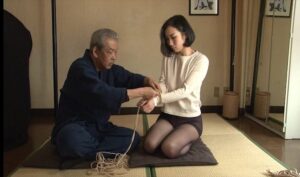
There are many ways to approach rope. Some begin with patterns, others with technique, others still with spectacle. Yukimura style shibari begins somewhere quieter. It begins with attention, embracing the essence of Yukimura Style Shibari.
In this approach, rope is not the focus in itself. It is a medium, a way of reaching another person, of creating a shared moment that unfolds in real time. What matters is not how intricate a tie appears, but how it feels, how it changes, and how two people move through it togethe
The rope is simply the thread. The experience is what it weaves.
A Different Center of Gravity
In many modern rope styles, the emphasis falls on structure. Clean lines. Symmetry. Repeatable forms that can be taught, practiced, and refined. There is value in that, and beauty too.
Incorporating Yukimura Style Shibari into your practice enhances the connection between partners.
But Yukimura style shibari shifts the center of gravity.
Instead of asking, “How do I execute this tie correctly?” it asks, “What is happening between us right now?”
The person being tied is not a canvas for technique. They are the center of the experience. Their breath, their tension, their small shifts in posture or expression become signals. The person tying learns to notice these signals, to respond to them, to let them guide what happens next.
Nothing is fixed. Nothing is performed for an audience. The moment is built from response, not from plan.
Simplicity That Opens Depth
At first glance, this style can seem deceptively simple. Fewer ropes. Fewer steps. Less emphasis on elaborate structures.
Yukimura Style Shibari highlights the beauty in simplicity.
But this simplicity is not an absence. It is an opening.
When there is less to manage technically, more becomes visible. Timing becomes sharper. Small adjustments carry weight. A pause can change the entire tone of a moment.
Instead of complexity in the rope, the complexity emerges in the interaction.
A slight hesitation. A shift of weight. A change in breathing. These become the language.
And like any language, it is learned not by memorizing sentences, but by listening.

Yukimura Style Shibari: The Living Exchange
In this style, nothing meaningful happens without response.
The principles of Yukimura Style Shibari emphasize mutual respect and awareness.
The person being tied is not expected to remain still or silent. Their reactions are not interruptions. They are the material of the experience itself.
Sometimes there is resistance, a pulling away, a tension that creates friction in the interaction. Instead of being corrected or removed, that resistance is engaged with. It becomes something to explore, something that gives shape to the moment.
Engaging with Yukimura Style Shibari allows for deeper emotional connection.
Sometimes there is a heightened awareness, a sense of being seen in a way that feels vulnerable or exposing. This, too, is not accidental. It is part of what gives the experience its emotional texture.
And sometimes, there is play. Not in the sense of something light or trivial, but in the sense of something exploratory. A back-and-forth. A testing of boundaries, rhythms, and possibilities. The rope becomes a way of asking questions and discovering answers together.
The result is not a fixed scene, but a living exchange that changes from moment to moment.
What You’ll Experience in Class
In class, you will discover the nuances of Yukimura Style Shibari.
Stepping into a class built around this approach can feel different from what people expect.
There is, of course, technique. You will learn how to handle rope safely and effectively. You will learn foundational ties. You will learn structure.
But that is not where the learning ends, or even where it truly begins.
You will spend time developing awareness. Learning how to notice small details. Learning how to slow down enough for those details to appear. Learning how to respond without rushing to control the outcome.
Exploring Yukimura Style Shibari involves understanding each partner’s responses.
Exercises are designed not just to show you what to do, but to help you feel what is happening.
If you are the person tying, you will learn how to move away from rigid sequences and into responsiveness. How to create rhythm. How to allow a moment to unfold instead of forcing it forward.
If you are the person being tied, you will explore how to participate actively. Not by performing, but by allowing your natural reactions to come through. By recognizing that your experience is not secondary, but central.
One of the most common realizations people have is that there is no single “correct” way to react. There is only honesty in the moment, and the willingness to let that honesty be seen.
Practicing Yukimura Style Shibari, you learn to embrace spontaneity.
A Shared Space of Attention
At its best, this style creates a kind of shared focus that can feel surprisingly intense, even with the simplest materials.
Time can stretch. Small movements can feel amplified. The outside world fades slightly as attention narrows to what is happening between two people.
This is not something that can be forced. It emerges when both people are engaged, when both are listening in their own way.
Yukimura Style Shibari fosters a unique connection through shared experiences.
The rope does not create that connection on its own. It simply gives it form.
Who This Is For
This approach resonates with a wide range of people.
For beginners, it offers a foundation that is not built on memorizing complex techniques, but on understanding how to connect and communicate. That foundation tends to carry forward into everything else they learn.
This approach to Yukimura Style Shibari can transform one’s practice.
For more experienced practitioners, it can feel like a shift in perspective. A way of moving beyond structure into something more fluid, more responsive, more alive.
And for anyone drawn to the emotional and interpersonal dimensions of rope, it offers a path that keeps those elements at the center rather than at the edges.
In the End
It is easy to think of rope as something you do.
Ultimately, Yukimura Style Shibari transcends mere technique.
In this style, it becomes something you share.
Not a display. Not a performance. Not a checklist of techniques completed correctly.
But a moment, shaped by attention, guided by response, and held together by something quieter than technique.
Something that, once felt, changes the way you understand even the simplest tie.
By exploring Yukimura Style Shibari, you redefine your understanding of rope.