
Key Terms
Understanding the core concepts in Yukimura Style Shibari is essential for practitioners.
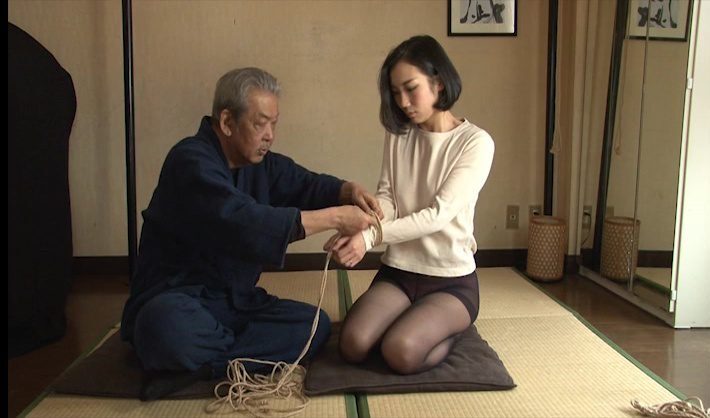
The concepts below appear repeatedly in Yukimura Haruki’s lessons, demonstrations, and recorded discussions of rope practice. Many are ordinary Japanese words, but within the context of kinbaku they acquire specialized meanings related to the emotional and relational dynamics of rope.
Rather than describing technical procedures alone, these terms reflect Yukimura’s understanding of rope as a form of communication and erotic play between two people.
Rope Mechanics
縄尻 (なわじり) — Nawajiri
The rope tail as a line of communication
In ordinary Japanese rope terminology, 縄尻 simply refers to the free end of the rope. In Yukimura-ryū, however, the term carries a much more specific meaning.
Yukimura described the rope tail as the primary means of communicating with the person being tied.
Through small movements of the rope end, the person tying can:
- signal intention
- apply pressure
- tease or caress
- provoke emotional reactions
The rope becomes a sensory line connecting the two participants. In many scenes multiple nawajiri points exist simultaneously—often at the wrists, ankles, neck, or chest—allowing the person tying to interact with the partner in different ways.
In this sense the rope tail functions like the strings of a puppet, but instead of manipulating a body mechanically it transmits emotional signals between participants.
遊び (あそび) — Asobi
Slack within the rope
The term 遊び refers to intentional looseness or slack within a mechanical system. In engineering it describes the slight freedom of movement that prevents a mechanism from becoming rigid.
Yukimura applied this concept directly to rope.
A rope that is pulled completely tight leaves the partner unable to move or react. When a small amount of slack remains, however, the body retains the ability to shift and respond. These subtle movements become part of the conversation between person tying and partner.
Asobi therefore preserves the flexibility of the scene. It allows rope to remain responsive rather than mechanical.
縄の荷 (なわのに) — Nawa no ni
Feeling the load of the rope
Yukimura often emphasized the importance of sensing the tension carried by the rope.
When tying, the person tying must feel how the partner’s body pushes back against the rope. This tension provides information about the partner’s posture, resistance, and emotional state.
If the rope is applied without sensing this load, it will not “settle” naturally on the body.
The rope must follow the body rather than forcing the body into an artificial structure.
Interaction and Communication
誘い (さそい) — Sasoi/ 誘い込み—Sasoi-komi
Invitation into the scene
Before the rope begins moving, Yukimura often spent time interacting with the partner through touch, conversation, or simple physical closeness.
These gestures function as invitation.
Rather than immediately restraining the partner, the person tying gradually draws them into the emotional space of the scene.
Sasoi establishes the atmosphere in which the rope interaction will unfold.
抵抗 (ていこう) — Teikō
Resistance
Resistance is a central element of Yukimura’s rope philosophy.
The partner may:
- pull slightly against the rope
- hesitate before complying
- resist certain movements
This resistance is not treated as a problem but as a necessary component of the interaction.
Without resistance there is no tension. Without tension there is no play.
The person tying’s task is not to overpower the partner but to understand and work with that resistance, gradually transforming it into participation.
ボキャブラリー — Vocabulary
Yukimura sometimes described the partner’s reactions as her vocabulary.
Facial expressions, body movement, and resistance become forms of communication. The person tying must learn to read these signals and respond accordingly.
The rope scene therefore resembles a conversation in which both participants contribute meaning through their reactions.
駆け引き (かけひき) — Kakehiki
Strategic emotional negotiation
Kakehiki refers to the subtle negotiation that occurs during seduction or flirtation.
In rope scenes this negotiation appears in the shifting balance between:
- resistance
- invitation
- teasing
- emotional exposure
The person tying suggests intentions without revealing them completely, allowing tension and anticipation to build.
Emotional Dynamics
恥ずかしい (はずかしい) — Hazukashii
Embarrassment and exposed desire
One of the emotional states Yukimura valued most highly in rope scenes was hazukashii.
This term describes a feeling of embarrassment, self-consciousness, or emotional exposure.
Rather than being forced upon the partner, this state often emerges gradually as the partner becomes aware of her own vulnerability or desire.
Small gestures, teasing language, and subtle rope positions can provoke this awareness.
Yukimura often remarked that the moment when the partner makes a slightly troubled or embarrassed face is one of the most beautiful moments in rope.
色気 (いろけ) — Iroke
Erotic charm
Iroke refers to sensual charm or erotic presence.
Within rope scenes it emerges through:
- posture
- facial expression
- emotional openness
The person tying’s task is not simply to restrain the body but to draw out this sensual quality.
情愛 (じょうあい) — Jōai
Affectionate eroticism
Despite the teasing and tension present in many rope scenes, Yukimura’s rope often carried an undercurrent of affection.
The interaction could include tenderness, care, and emotional closeness.
This affectionate dimension prevents the scene from becoming purely antagonistic.
Energy and Attention
気 (き) — Ki
Energy of the scene
Ki refers to the shared energy or atmosphere between participants.
When the Ki of the scene is strong:
- attention flows between the participants
- reactions deepen
- simple gestures carry emotional weight
When Ki weakens, the interaction becomes mechanical.
Yukimura trained students not to create Ki deliberately but to notice when it appears or disappears.
気が抜ける (きがぬける) — Ki ga nukeru
Loss of energy
Certain movements can break the emotional tension of the scene.
For example, if the wrists move away from the body during tying, the emotional focus may collapse.
When this happens the atmosphere of the scene dissipates.
Avoiding these moments of collapse is one of the person tying’s primary responsibilities.
Structure of the Rope Scene
最初のアタック — The First Attack
Yukimura frequently stated that the most important moment of the rope scene occurs at the beginning.
The moment when the person tying approaches from behind, touches the partner, or begins positioning the hands can determine the entire emotional direction of the interaction.
If the connection forms early, the rest of the scene unfolds naturally.
引導を渡す (いんどうをわたす) — Indō o watasu
The declaration of control
During the first tightening of the rope on the wrists, Yukimura sometimes described a moment he called “giving the final rites.”
This brief tightening signals the person tying’s control of the situation.
Immediately afterward the rope may be loosened slightly so the scene can continue comfortably.
The gesture is symbolic rather than purely technical.
縄遊戯 (なわゆうぎ) — Nawa Yūgi
The rope game
Yukimura often described rope as a game played between two people.
Within this game:
- resistance creates tension
- embarrassment reveals vulnerability
- desire emerges through interaction
The goal is not simply restraint but the unfolding of erotic play.
開放 (かいほう) — Kaihō
Release
The final stage of the rope scene is release.
Kaihō involves more than removing the rope. It includes restoring emotional balance and guiding the partner gently out of the scene.
This moment completes the emotional arc of the interaction.