
Yukimura Ryū
From around the mid-1990s, Yukimura Haruki began developing his own distinctive style of kinbaku, placing emphasis on the dynamics of the tying process and communication with the receiver. By the 2000s, this approach had been fully realized as what is now known as the Yukimura style or Yukimura Ryū.
If Yukimura-ryu is a language, then its lineage is not a dictionary. It is a series of conversations carried across bodies, rooms, and years.
Unlike systems that prioritize fixed forms or repeatable patterns, transmission in Yukimura-ryu moves through direct experience. Students do not simply learn how to tie; they learn how to perceive, respond, and adapt. What is passed down is less a set of techniques and more a way of seeing: how to feel tension before it becomes visible, how to wait for a reaction before acting, how to allow the rope to become a medium rather than a tool.
At the center of this process is the relationship between teacher and student. Instruction is often situational, even improvisational. A correction might not come as a verbal explanation, but as a subtle intervention: a shift of the hand, a pause introduced at the right moment, a demonstration that reveals timing rather than structure. The student learns not by memorizing sequences, but by absorbing timing, distance, and intention.
Formal recognition within Yukimura-ryu reflects this emphasis. Certification as an instructor is not granted for technical proficiency alone, but for the ability to embody and transmit the core principles of the style. Beginning in 2012, designated instructors were recognized in a numbered lineage, each representing not just skill, but a continuity of approach. This lineage extends internationally, carried by practitioners who adapt the method across cultures while maintaining its essential focus on communication and emotional exchange.
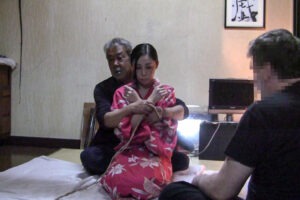
Importantly, transmission in Yukimura-ryu is not static. Each generation does not simply preserve the style, but reanimates it. The rope remains the same, but the conversations it enables continue to evolve. In this way, lineage is not a fixed inheritance. It is an ongoing negotiation between past and present, teacher and student, rope and body.
Ryū and Ha: What Changes, What Continues
In Japanese artistic traditions, a ryū (流) is often imagined as a river system: a coherent current of practice shaped by a founder, carried forward through generations. A ryū preserves not just techniques, but principles, aesthetics, and ways of seeing. It has a recognizable flavor. You can step into it anywhere along its course and still feel the same water moving beneath your feet.
A ha (派), by contrast, is a branching current. Not a rebellion, not a break, but a distinct articulation within the larger flow. A ha emerges when a practitioner internalizes a ryū deeply enough that their expression begins to take on its own structure, emphasis, and voice. It is both of the ryū and not identical to it.
If the ryū is the river, the ha is a channel cut through new terrain. The water is the same, but the landscape shapes how it moves.
In practice, this means:
- A ryū transmits a foundational philosophy and method
- A ha interprets, emphasizes, and evolves that method
- A ryū seeks continuity
- A ha accepts variation as a form of continuity
In many classical arts, ha are not deviations but signs of vitality. They indicate that the tradition is still alive enough to be thought with, not just preserved.
Haru Yutaka-ha: A Living Interpretation of Yukimura-ryū
My work sits within the lineage of Yukimura Haruki, but it does not attempt to replicate it.
What I practice and teach can be understood as Haru Yutaka-ha (春豊派), a branch of Yukimura-ryū shaped through years of direct study, teaching, and transmission in a Western context. The foundation remains unchanged: rope as communication, the centrality of the receiver, the importance of timing, restraint, and emotional exchange. These are not negotiable. They are the river itself.
But how that river moves through my work has been shaped by different terrain.
Teaching thousands of students, many encountering rope for the first time, has required a different kind of articulation. Concepts that were once transmitted through immersion and proximity must often be made visible, structured, and repeatable enough to be learned, without losing their essential fluidity. This tension between clarity and openness sits at the core of Haru Yutaka-ha.
In this interpretation:
- Greater emphasis is placed on pedagogy, making subtle concepts teachable without reducing them to rigid rules
- The role of observation and delay is made explicit, helping students learn how to wait, not just act
- Foundational ties are used not as ends in themselves, but as frameworks for interaction
- The emotional vocabulary of the work is adapted for a Western audience, while maintaining its depth and complexity
Haru Yutaka-ha is not a departure from Yukimura-ryū. It is an attempt to continue it under different conditions.
The rope still asks the same question: can you feel the other person through it?
The answer, however, must now be learned, taught, and rediscovered in a different language, with different students, in different rooms. And so the branch grows, not away from the river, but alongside it.