
Yukimura Haruki (1948–2016)
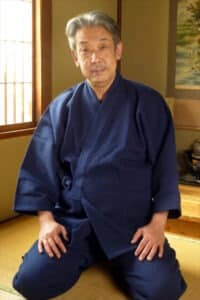
Yukimura Haruki was one of the most influential and quietly revolutionary figures in modern Japanese rope bondage. Emerging prominently in the mid-1990s, he developed a distinctive approach to tying that shifted focus away from fixed patterns and toward something far more elusive: the living interaction between the person tying and the person being tied.
By the early 2000s, this approach had crystallized into what is now known as Yukimura-ryu. Rather than treating rope as a system of techniques, Yukimura treated it as a language, one capable of conveying emotion, tension, play, and intimacy without words. His work emphasized what he described as the “dynamics of the tying process” and the importance of communication with the person being bound.
At the heart of Yukimura’s method is the idea that rope is not static. It is not something applied to a passive body. Instead, it is an evolving exchange, shaped moment by moment through touch, resistance, and response. This philosophy is perhaps most clearly expressed in his concept of nawajiri (縄尻), which in Yukimura’s teaching does not simply refer to the end of the rope, but to a functional line of communication between partners. Through subtle variations in tension, angle, and movement, the rope becomes a conduit for emotional and physical dialogue.
Yukimura often described rope as a form of play, or nawa yuugi (縄遊戯), where the act of tying becomes a kind of improvised exchange. He compared it to a wordless romance or a negotiation of feeling, where both participants actively shape the experience. In his view, the most compelling rope was not the tightest or most technically complex, but the most responsive. His characteristic “loose rope” approach required sensitivity and control, allowing the person being tied to move, react, and express themselves within the structure of the tie.
Throughout his career, Yukimura trained a small group of dedicated students, formally recognizing a limited number of instructors who would carry his teachings forward. These individuals helped transmit his ideas both within Japan and internationally, ensuring that his influence would continue to shape contemporary rope practice long after his passing.
Yukimura Haruki’s legacy is not a collection of techniques, but a way of thinking about rope. His work invites practitioners to move beyond performance or pattern, and toward a deeper, more intimate form of connection. Today, Yukimura-ryu remains one of the most distinct and philosophically rich approaches to rope bondage, centered on communication, responsiveness, and the subtle art of emotional exchange.