
New Approaches to Old Shibari Ties
In Yukimura-ryū, rope is never just a matter of position. It is not a catalog of ties, nor a sequence of techniques to be executed correctly. It is, above all, a way of entering into a particular kind of relationship. The form matters, but only insofar as it shapes what passes between two people.
Among the many positions one might encounter, two return again and again: tie (前て縛り/maete) the hands-in-front tie and the 後手縛り(ごてしばり / gote), the hands bound behind the body. They appear, at first, to stand in opposition. One seems open, the other restrictive. One suggests possibility, the other control. But within Yukimura’s work, they are not opposites at all. They are two ways of approaching the same question, two different paths into the same intimate terrain.
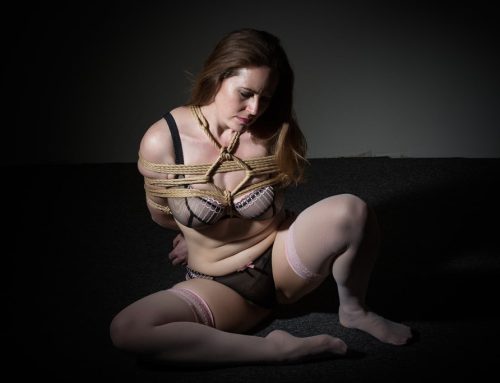
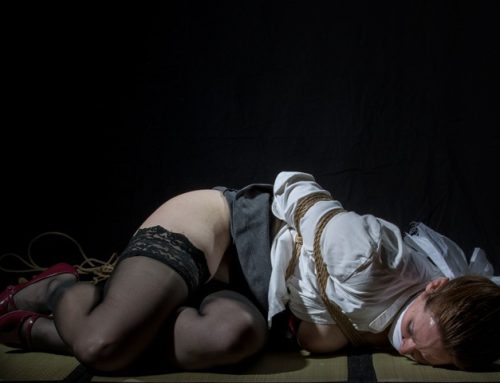
The gote is not primarily a technical structure. It is a moment. The act of bringing the hands behind the body creates an immediate shift. Before any knot is secured, the body has already begun to change. The chest opens, the shoulders draw back, awareness sharpens. The person being tied feels the presence behind them, feels the approach of something they cannot fully see. Yukimura emphasized this again and again, reminding his students that the most important part of the tie often happens before the rope is even applied.
“後ろに来るということは、それだけでドラマがあるやないですか。
” Simply coming behind someone already contains drama.”
In this sense, the gote is a threshold. It marks a point of no return, not because it immobilizes the body completely, but because it clarifies the situation. It signals intent. It gathers attention. It creates a shared focus that can be deepened through the smallest movements. And yet, even here, Yukimura resists the idea of total control. The person being tied is not meant to become passive.
“別におとなしいしてんでも、抵抗してくれたって、全然大丈夫やで。”
There is no need to be still, he tells the model. You may resist.
This is the paradox at the heart of Yukimura-ryū. Even in a position that appears restrictive, responsiveness must remain alive. The rope is not there to eliminate reaction, but to sharpen it.
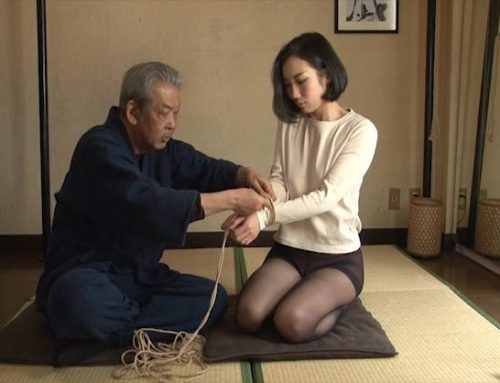
If the gote clarifies the line between two people, the hands-in-front tie opens that line into a space of possibility. Here, nothing is fully taken away. The arms remain visible, mobile, expressive. The person being tied can hesitate, adjust, protect themselves, or reveal themselves. The rope does not impose a fixed shape so much as it creates a condition in which reaction becomes unavoidable.
In this setting, Yukimura’s idea of 縄遊び (rope play) becomes particularly vivid. Rope is not something that holds the body in place. It is something that invites the body to respond. The smallest shift in distance, the slightest change in tension, can alter the entire atmosphere. A pause becomes meaningful. A glance becomes charged. What matters is not the form achieved, but the exchange that unfolds within it.
This is why Yukimura placed so much emphasis on subtle control.
“小手先で…コントロールだけで寝かしたいんです。”
“I want to be able to lay them down using just my fingertips… just control alone.”
He wanted to move a person with the smallest possible gesture, to guide rather than force. Too much effort, too much visible exertion, would diminish the effect. The more you support or compensate, the more the emotional intensity fades. The rope must suggest, invite, and at times deceive, rather than simply overpower.
Seen in this way, the distinction between hands-in-front and gote begins to dissolve. They are not categories of difficulty or stages of progression. They are different configurations of the same underlying principle. The gote gathers and concentrates attention, creating a strong initial connection. The hands-in-front tie disperses that attention into a set of reactions, allowing the interaction to breathe and evolve.
Yukimura’s teaching consistently returns to simplicity.
“雪村流で学ぶのは型ではなく、受け手との縄を使ったコミュニケーションの方法なのです。”
“What you learn in Yukimura-ryū is not forms, but how to communicate with your partner through the rope.”
What one learns is not form, but communication through rope. Over time, his work became increasingly minimal, stripping away unnecessary complexity in order to focus more clearly on what mattered. The ties themselves are often simple, even deceptively so. What is difficult is not the structure, but the sensitivity required to use it well.
At LA Rope Dojo, this approach shapes how we teach. Hands-in-front ties are not treated as preliminary exercises to be left behind, nor is the gote presented as a final goal. Each reveals something essential. The hands-in-front tie exposes the immediacy of reaction, the importance of timing and awareness. The gote deepens the connection, challenging the person tying to maintain responsiveness even within apparent restriction.
In both cases, the rope is asking a question. With the hands in front, the question is open: what will you do? With the hands behind, it becomes more pointed: what do you feel now that your options have changed? Neither question has a fixed answer. The value lies in how it is asked, and how carefully one listens for the response.
Ultimately, these are not two separate techniques, but two expressions of the same philosophy. Rope is not something you do to another person. It is something you create with them, moment by moment, through attention, timing, and care. In that shared space, even the simplest tie can become profound.

Leave A Comment